I am tired of a world where almost anything can be made instantly.
A picture can be generated in seconds. Ideas, images, writing, and designs can be created with the click of a button.
And yet, I think this is exactly why making matters more than ever.
Because there is something deeply human about making with your hands and giving it your time.
Making something slowly feels different.
Learning how to do something with your hands, making mistakes, unpicking them, starting again, and eventually looking at what you have created and knowing: I made this.
That, to many other makers and me, is becoming the ultimate luxury.
We have forgotten the value of slow
We expect everything immediately. We consume at an incredible rate. We scroll past hundreds of images before breakfast and can have almost anything delivered to our door within days.
But speed doesn’t necessarily make life richer.
Sometimes it does the opposite.
Making asks us to slow down. It asks us to pay attention. To feel and notice.
When I sit down with cord and begin to knot, there is no shortcut. One knot has to follow another. My hands have to learn the rhythm. My mind has to settle into the process.
And somewhere in that repetition, something happens.
I become present.
Macramé is particularly beautiful in this way because the process is so visible. Every knot is part of the finished piece. Every strand has a history. Every small imperfection tells you that a human being was there.
It hasn’t been produced by an algorithm.
It has been made slowly, deliberately and by hand.
And I think we are going to value that more and more.
Below is a post from my Instagram about handmade!
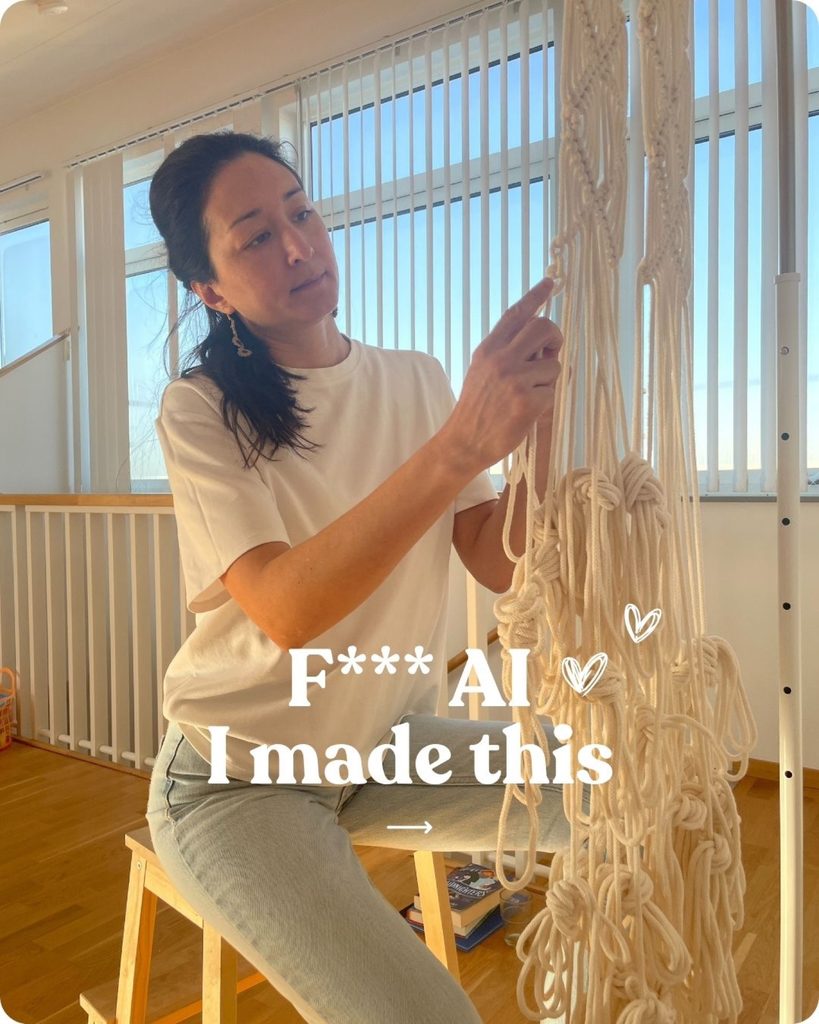
Macramé is more than decoration
Macramé is often seen simply as a beautiful craft — something we use to make wall hangings, plant holders, bags or beautiful objects for our homes.
But it is much more than that.
Macramé is an ancient way of making.
For generations, people have used knotting to create useful and beautiful things. Knowledge has been passed from one pair of hands to another, often without technology, without written instructions and without the need for anything more than cord, patience and practice.
There is something incredibly powerful about being part of that lineage.
When we learn an old craft, we aren’t just learning how to make an object.
We are keeping knowledge alive.
We are saying that this skill is still worth knowing.
That these techniques still deserve our attention.
That not everything needs to be faster, easier or automated.
In a world dominated by AI, being human becomes the point
I don’t think AI is the enemy of creativity.
In many ways, it is an extraordinary tool. It can help us explore ideas, solve problems and see possibilities we might not have considered.
But there is a difference between creating something and experiencing the act of making.
And I think that distinction is going to become increasingly important.
When technology can produce almost anything on demand, the things that carry evidence of human time become more meaningful.
The slightly uneven edge.
The variation in the knots.
The texture of the fibre.
The hours that went into making something.
The person who sat at the table and made it.
These things cannot be replicated simply by making something that looks handmade.
Because the value isn’t only in the finished object.
The value is in the human story behind it. And everyone has a story, emotions and ideas to share.
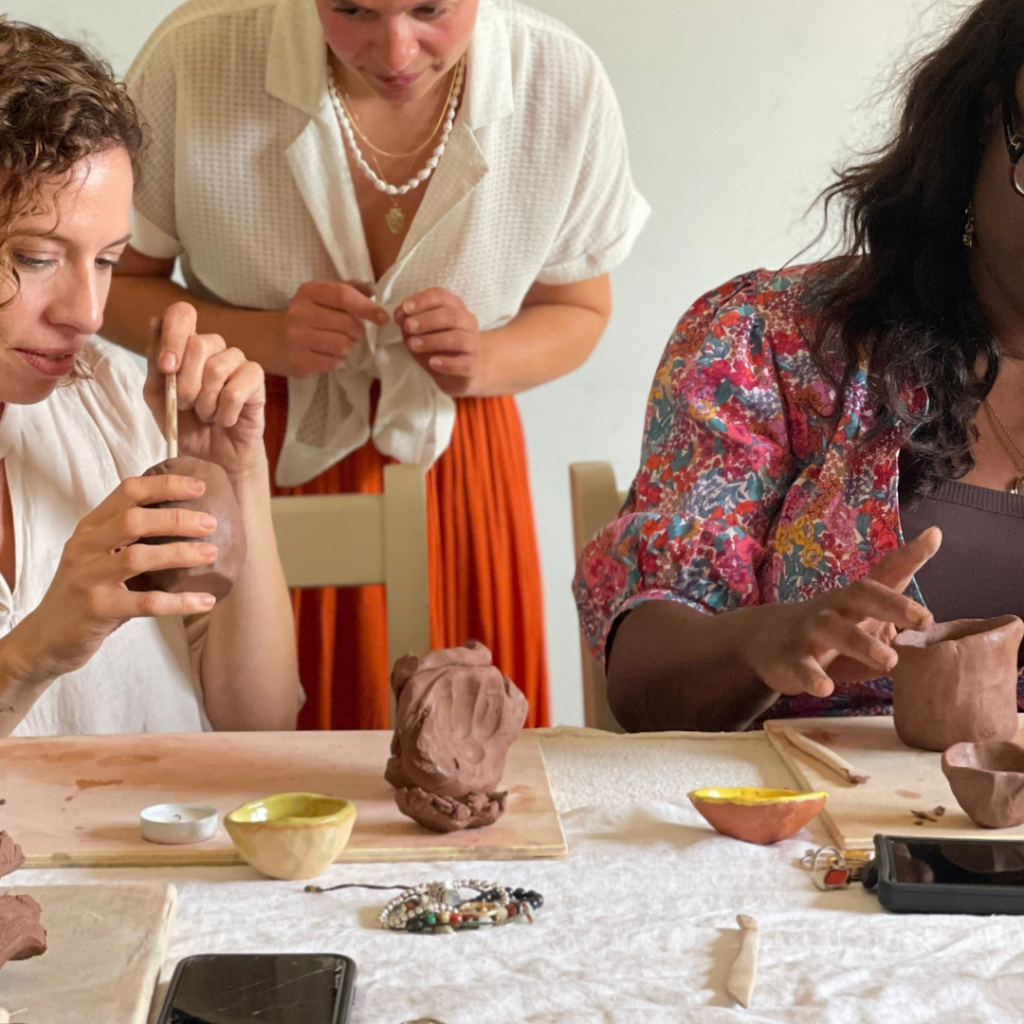
Making is a form of resistance
There is something quietly rebellious about choosing to make.
To sit down and spend three hours creating something that you could probably buy for less.
To repair something rather than replace it.
To learn a skill instead of outsourcing it.
To make one beautiful thing instead of buying ten disposable things.
It is a decision to value time over speed, quality over quantity and connection over consumption.
And perhaps that is why handmade objects feel different.
We don’t just see the object.
We sense the time, love and care inside it.
Creativity needs somewhere to live
I believe creativity is something we all have.
It doesn’t belong exclusively to artists or designers. It doesn’t require a degree, a studio or a particular kind of personality.
Sometimes creativity is simply giving yourself permission to make something.
A knot.
A shape.
A pattern.
A piece that didn’t exist yesterday.
Macramé gives creativity somewhere to live in the physical world.
It takes an idea from your head and moves it through your hands.
And that connection between the mind and the hands is something I think we desperately need to protect.
Because the more of our lives move onto screens, the more valuable it becomes to create something that exists outside of one.
Handmade is the new luxury
Luxury used to be about having more.
More possessions. More choice. More convenience.
But perhaps the definition of luxury is changing.
Maybe luxury is having the time to make.
The time to learn.
The time to sit quietly.
The time to create something slowly enough that you become part of the process.
A handmade object doesn’t have to be perfect to be valuable.
In fact, its imperfections might be exactly what makes it precious.
Because they remind us that a person made it.
Someone chose the material.
Someone tied every knot.
Someone spent their time on it.
And time, when you really think about it, is the one thing none of us can make more of.
So perhaps handmade really is the new luxury.
Not because it is expensive.
But because it is human.
And in a world where machines can make almost anything, choosing to make something with our own two hands might be one of the most meaningful things we can do.
The handmade revolution!
Making together
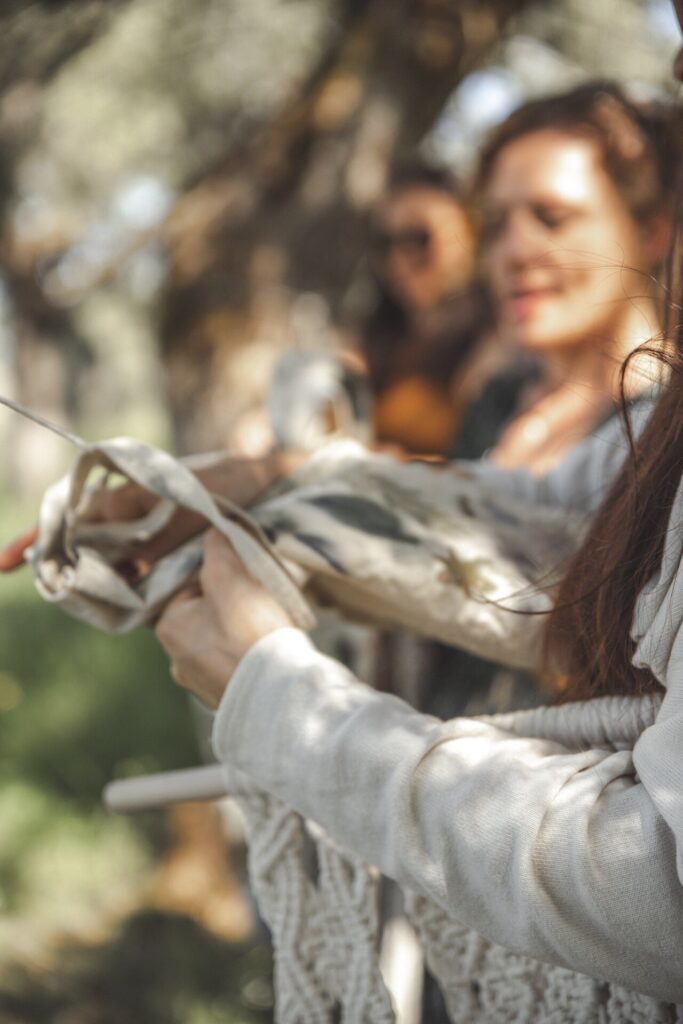
And making together, in a group of women, is even better.
There is something deeply special about creating in the company of others — a place and a time to make, to share stories, to laugh, to talk about life and sometimes simply to sit together without needing to fill the silence. It feels a little like the olden days, when making was woven into everyday life and women would gather to work with their hands while sharing news, stories and experiences.
Today, when so many of us can feel disconnected despite being more digitally connected than ever, these moments matter. A table, some cord, a few knots and a group of women can become a small antidote to loneliness. A place for encouragement, support and friendship. A place where we can teach each other, learn from one another and remind ourselves that we don’t have to do everything alone.
Because making together isn’t just about what we create.
It is about creating connection.
It gives us a reason to gather, a reason to slow down and a feeling of being part of something bigger than ourselves.
And perhaps that is another kind of luxury we are beginning to rediscover — the luxury of time together, of community, of belonging, and of making something with our hands while making space for one another.
